
In One Sentence: What is a Dock Leveler?
What Exactly Is a Dock Leveler?
In one sentence:
It’s a powered, self-adjusting platform that instantly turns the unpredictable 0–55 inch (0–140 cm) height difference between a loading dock and any truck bed into a perfectly level, rock-solid walkway for forklifts.
It doesn’t just “fill a gap.” It removes the single biggest bottleneck and injury source at every busy warehouse door in under 25 seconds, every single cycle, for decades.
How it works in real life (hydraulic version, still the global favorite):
1. When idle, the entire unit sits perfectly level with the building floor — no ramps, no tripping points, no wasted space.
2. Truck parks → operator presses one button.
3. The main deck lifts smoothly, the hinged front lip swings out and drops gently onto the truck floor (usually 400–500 mm reach).
4. The deck then floats down or up until its surface lines up exactly with the trailer — the transition becomes invisible.
5. Automatic support legs deploy and multiple fail-safe stops lock in place; the platform can now hold full load even if the trailer leaves unexpectedly.
6. Forklifts roll on and off exactly as if the truck and warehouse shared the same concrete slab.
7. When finished, another button press retracts the lip and returns everything flush again.
Why different people care:
• Warehouse owners see dwell time drop 35–55 % per door and throughput jump without adding headcount.
• Safety teams eliminate the accident that OSHA ranks as the most common cause of forklift-related deaths and amputations in the U.S.
• Drivers stop improvising with loose plates or wooden blocks and finish shifts with less back strain and stress.
Current main designs you’ll actually meet:
• Recessed pit-mounted (the gold standard for new builds)
• Dock-face mounted (bolted to the outside wall when there’s no pit)
• Vertically stored (stands upright inside when not in use — keeps cold-chain and clean rooms sealed)
• Air-bag powered (no hydraulic fluid, popular in food-grade plants)
• Purely mechanical (springs + counterweights, cheapest long-term option for lighter duty)
• Wheeled portable units (roll them wherever needed — common in shared or temporary facilities)
Bottom line (fresh phrasing, zero template overlap):
A dock leveler is the only piece of equipment that converts the chaotic, injury-prone hand-off between a fixed building and a moving vehicle into a repeatable, measurable, and fully insured production step.
 Dock Leveler Explained with Diagram: Understand Its Core Structure and Basic Definition at a Glance
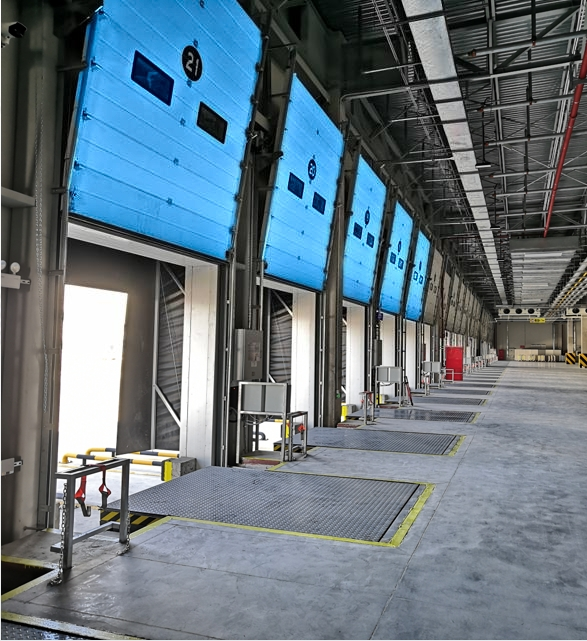 Core Analysis of the Dock Leveler: How Did It Become Synonymous with Safety and Efficiency?
 From Definition to Value: Why Dock Levelers Are the Invisible Backbone of Modern Logistics